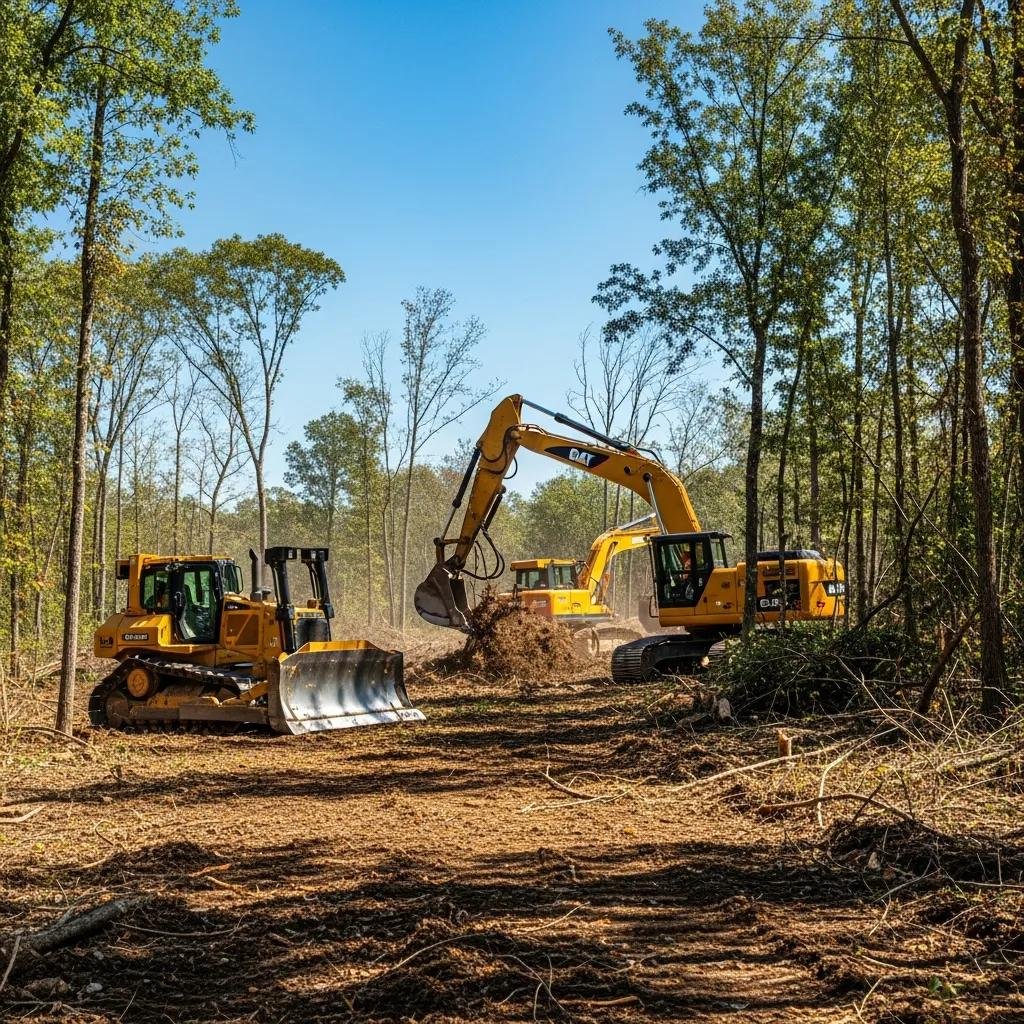
Comprehensive Land Clearing Services: Planning & Execution Guide for Effective Site Preparation
Land clearing is the deliberate removal of vegetation, stumps, and obstacles to prepare a parcel of land for development, agriculture, or landscape restoration. This guide explains the land clearing process, why it is essential for safe, build-ready sites, and how proper planning reduces schedule risk and environmental harm. You will learn how to assess a site, secure permits, choose appropriate clearing methods such as forestry mulching or dozing, match equipment to terrain, manage debris and erosion control, and evaluate cost drivers that affect project budgets. The article maps a practical step-by-step execution plan and compares methods with EAV-style tables to help decision-makers and property owners choose the best approach. Throughout, we integrate best practices for regulatory compliance, sustainable techniques that limit soil disturbance, and checklists for vetting professional contractors, ensuring this site preparation guide functions as an actionable reference for residential, commercial, and agricultural projects.
What Is the Land Clearing Process and Why Is It Essential?
The land clearing process is the coordinated set of actions to remove trees, brush, roots, stumps, and debris to create a workable, safe site for construction, farming, or landscape management. The mechanism involves surveying the site, identifying hazards and protected features, selecting a clearing method, mobilizing equipment and crews, and completing debris handling and grading to safe tolerances. The specific benefit is a buildable surface that meets access, foundation, and utility installation requirements while reducing fire risk and improving site access. Current research and industry guidance emphasize planning and staged execution to protect soils and waterways during clearing and to minimize regulatory exposure. Understanding these fundamentals sets up the next discussion on how clearing directly enables development and the different project types that follow distinct workflows.
Land clearing enables construction by creating safe, graded surfaces and by exposing ground conditions needed for foundations, roads, and utilities; the following section explains the practical steps on-site and how outcomes differ by project type.
How Does Land Clearing Enable Property Development and Construction?
Land clearing enables development by removing impediments to excavation, grading, and installation of utilities, which shortens preconstruction timelines and reduces unforeseen costs. On a residential lot, clearing typically focuses on tree removal, stump grinding, and establishing a building pad and driveway access, while commercial sites require larger-scale earthmoving, grading to engineered tolerances, and coordinated utility corridors. By exposing soil and subgrade conditions, clearing allows geotechnical evaluations and proper foundation planning, which prevents later structural issues. Clearing also improves site safety by removing fuel for wildfires and eliminating hidden hazards that can injure crews; this risk reduction in turn protects schedules and budgets. These operational benefits lead naturally to considering the distinct requirements across residential, commercial, and agricultural land clearing projects.
What Are the Key Types of Land Clearing Projects: Residential, Commercial, and Agricultural?
Different land clearing projects have unique priorities based on scale, regulatory requirements, and intended use, which affects equipment, timing, and permitting. Residential lot clearing centers on lot lines, tree protection for neighboring properties, and efficient stump grinding for building pads, usually requiring less heavy equipment and shorter mobilization. Commercial site preparation commonly involves larger earthmoving fleets, engineered grading plans, stormwater management systems, and more rigorous permitting for erosion control and utility coordination. Agricultural clearing focuses on brush removal, fence-line access, and converting wooded or overgrown parcels into plantable fields with minimal soil compaction to preserve productivity. Assessing the project type early helps determine method selection, permitting needs, and budgeting, which is the topic we address next in the step-by-step planning and execution sequence.
How to Plan and Execute a Successful Land Clearing Project Step-by-Step
Successful land clearing depends on disciplined planning that begins with a documented site assessment and a clear scope, then proceeds through permit compliance, method selection, execution, and post-clearing stabilization. The mechanism of success lies in aligning site constraints with the right techniques and equipment while embedding environmental safeguards like silt fences and phased clearing. The main advantage for property owners is predictable schedules, controlled costs, and minimized regulatory risk. Below are concise steps to structure a project from initial survey to final grading, with estimated timeframes for common tasks.
- Conduct an initial site assessment and survey (1–3 days for typical residential lots).
- Research permits and environmental constraints, and secure approvals (1–6 weeks depending on jurisdiction).
- Select the clearing method and mobilize equipment and crew (1–7 days).
- Execute clearing, debris management, and rough grading (days to weeks depending on acreage).
- Implement erosion control and final grading, then schedule inspections (1–3 days).
This step-by-step checklist clarifies responsibilities and timelines and sets up the next section about the detailed elements of initial site assessment and planning.
What Are the Critical Steps in Initial Site Assessment and Planning?
Initial site assessment begins with a visual survey and documentation of vegetation types, slope conditions, soil classification, wetlands, and any nearby watercourses, followed by locating utilities and confirming property boundaries. A checklist approach—mapping trees, identifying invasive species, flagging steep slopes, and noting access points—reduces surprises during clearing and supports permit applications. Photographic records, basic topography notes, and any available survey stakes should be documented and shared with the clearing team and permitting authorities. Identifying sensitive areas early enables designers to plan buffer zones and choose less invasive options like mulching, which will be covered when we compare clearing methods. Proper assessment therefore directly informs permit strategy and cost estimates covered in the following subsection.
How to Navigate Permits and Environmental Compliance for Land Clearing?
Permitting starts with identifying jurisdictional authorities—local planning departments, state environmental agencies, and, where applicable, federal programs—and then matching project activities to permit triggers such as wetlands impact or significant tree removal. Common permits include local land development or grading permits, erosion and sediment control plans, and, in some cases, wetland or endangered species clearances; the timing for approvals often dictates project start dates. Practical steps include pre-application meetings with regulators, preparing clear site plans, and engaging ecological consultants for sensitive sites, which reduces the risk of enforcement actions. Understanding permit triggers early helps prioritize low-impact methods and phased clearing to keep the project compliant while maintaining momentum toward execution.
Which Land Clearing Methods and Techniques Should You Choose?
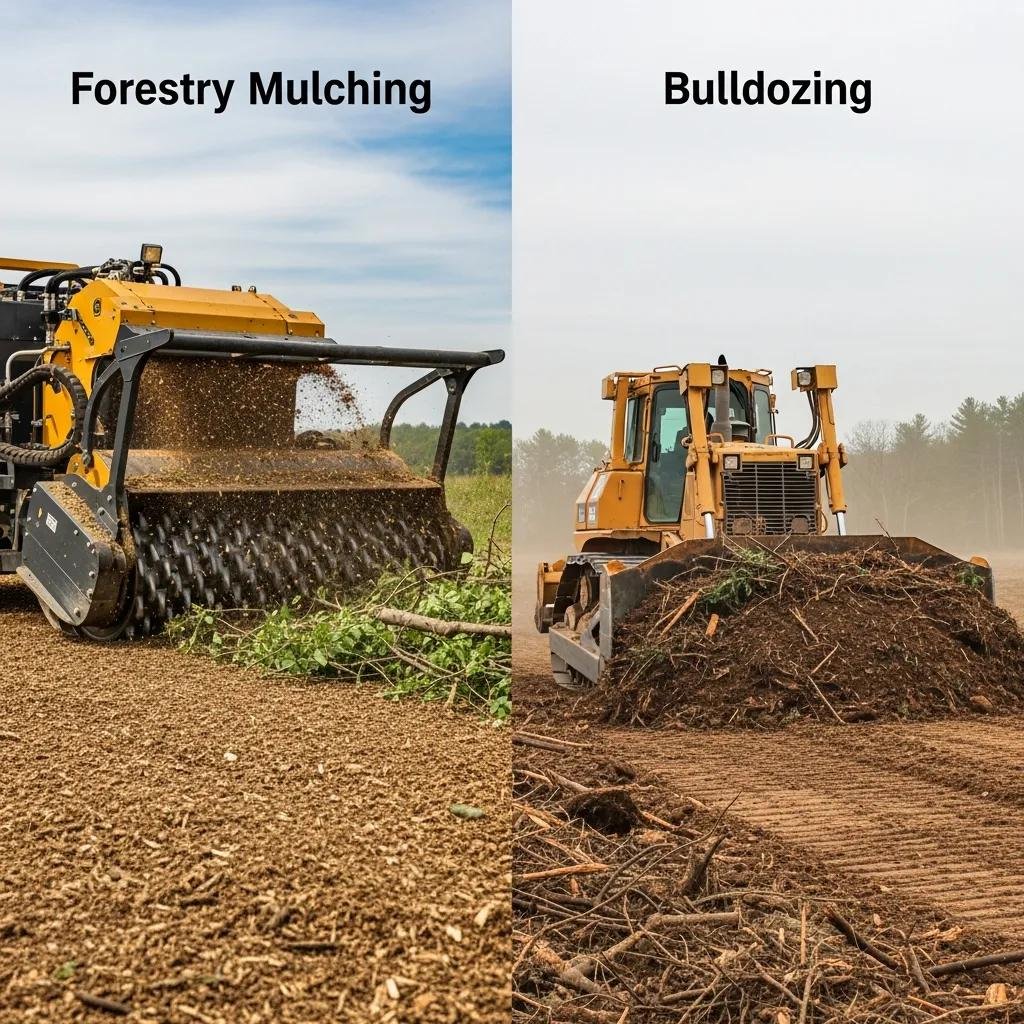
Choosing a land clearing method involves balancing speed, cost, environmental impact, and site sensitivity; common options include forestry mulching, dozing, manual clearing, stump grinding, and controlled disposal or hauling of debris. The mechanism for decision-making pairs site conditions—such as slope, soil, and vegetation—with method-specific trade-offs like soil disturbance, debris handling costs, and suitability for re-use of cleared material. Selecting the right technique yields lower disposal costs, reduced erosion risk, and better post-clearing soil conditions. The table below compares primary methods with their best use cases, pros/cons, and typical cost ranges to support quick, informed decisions.
| Method | Best Use Case | Pros / Cons / Typical Cost Range |
|---|---|---|
| Forestry mulching | Brush, small trees, slopes, sensitive areas | Pros: leaves mulch in place, reduces hauling, limits soil disturbance. Cons: less suited for large stumps; Cost: moderate per acre. |
| Dozing / Bulldozing | Open fields, large clearings, heavy tree removal | Pros: fast for large areas; Cons: high soil disturbance and haul costs for debris. Cost: higher mobilization, lower per-hour productivity. |
| Manual clearing | Small yards, near structures, sensitive features | Pros: precise, low disturbance; Cons: labor-intensive and slower. Cost: lower equipment costs, higher labor hours. |
This comparison shows forestry mulching as a strong sustainable choice for slopes and ecologically sensitive sites, while dozing is chosen for speed on open terrain and manual clearing for precision near structures; the next subsections expand on forestry mulching and the dozing/manual comparison.
What Are the Advantages and Applications of Forestry Mulching?
Forestry mulching grinds vegetation in place using a mulcher head mounted on an excavator or skid steer, instantly converting brush and small trees into a nutrient-rich mulch layer that protects soil and reduces erosion. The method reduces debris hauling, preserves topsoil structure, and is well-suited to slopes and buffer zones where access is limited or where runoff protection is a priority. Typical applications include roadside clearing, wildlife habitat management, fuel reduction projects, and preparing building pads where minimal soil disturbance is desired. Forestry mulching is particularly valuable when post-clearing erosion control and rapid revegetation are priorities, positioning it as a sustainable option that often reduces long-term site maintenance costs. Understanding this approach helps determine when to prefer mulching over heavier earthmoving techniques.
The effectiveness of mulching in mitigating environmental impacts, particularly regarding runoff and soil erosion, is well-supported by scientific studies.
Mulching for Runoff & Soil Erosion Control
Post-fire forest residue mulching using eucalypt bark strands have been proven effective for reducing hillslope runoff and erosion in field plots of different sizes (0.25–100 m 2 ).
Runoff and soil erosion mitigation with sieved forest residue mulch strips under controlled laboratory conditions, SA Prats, 2017
How Do Dozing and Manual Clearing Compare for Different Terrains?
Dozing uses heavy bulldozers and loaders to remove trees and level ground quickly, which makes it efficient for large, flat tracts but increases soil compaction and requires additional grading and reconditioning. Manual clearing employs crews with chainsaws, hand tools, and small machinery to protect sensitive areas and avoid collateral damage to nearby structures and root systems; it is slower but far less disruptive to soil. When terrain is steep or environmentally sensitive, manual or mulching approaches limit erosion risk compared with dozing; conversely, large commercial sites with uniform vegetation may achieve cost efficiencies with dozing followed by grading. Selecting between these techniques depends on slope, proximity to protected features, the need for rapid mobilization, and the desired post-clearing soil condition.
What Equipment and Resources Are Needed for Efficient Land Clearing?
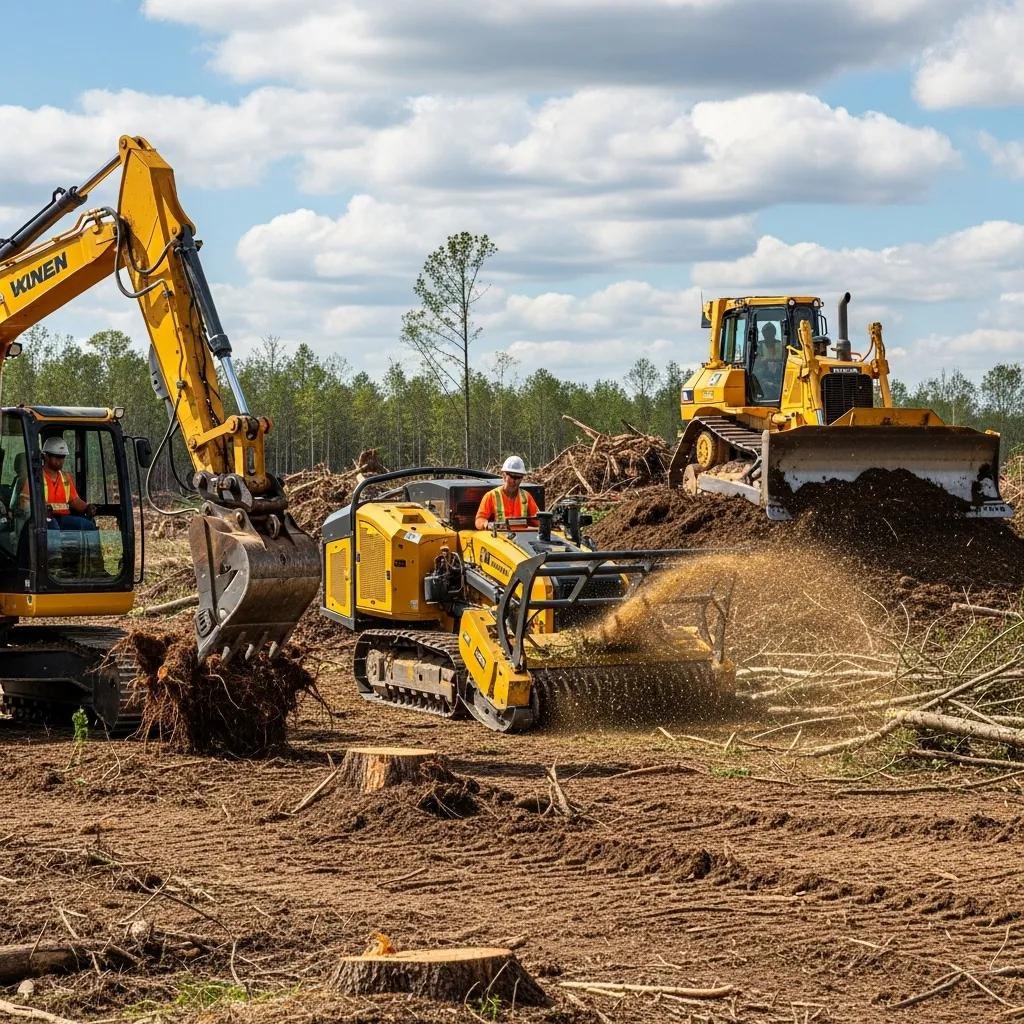
Efficient land clearing combines the right heavy equipment, trained personnel, and a logistics plan for debris handling and erosion control to deliver safe, timely site preparation. Equipment selection depends on project scale and terrain: small parcels benefit from skid steers and mini-excavators, while large tracts require excavators, bulldozers, mulchers, and haul trucks. Skilled operators and site supervisors ensure machines are used efficiently and safely, reducing downtime and the likelihood of incidents. The following table maps common equipment to primary functions and typical project scales so readers can match machinery to their site’s needs and budget.
| Equipment | Primary Function | Typical Project Scale / Notes |
|---|---|---|
| Excavator | Stump removal, digging, mulcher mounting | Small to large projects; versatile on slopes |
| Mulcher (head) | Vegetation grinding, mulching in place | Small to medium sites; preserves topsoil |
| Bulldozer | Bulk earthmoving and rough grading | Large commercial sites; increases speed |
| Loader / Dump Truck | Debris handling and hauling | All scales; needed when material is removed |
| Stump grinder | Focused stump removal and root grinding | Residential and precision work; lowers replanting issues |
This equipment mapping clarifies how matching tools to terrain improves efficiency and reduces unnecessary mobilization; the next subsections describe common heavy machines and the human resources required to execute projects safely.
Which Heavy Equipment Is Commonly Used in Land Clearing Operations?
Excavators perform stump extraction, trenching, and can mount mulcher heads to grind vegetation, making them versatile on many sites. Bulldozers and graders move large volumes of earth and shape final contours, which is essential for commercial site preparation and roadways. Skid steers and compact loaders navigate tight areas and handle brush and debris, while stump grinders and wood chippers address root systems and process timber for offsite disposal or chipping. Each machine contributes to a sequence—clear, process, haul, and grade—that minimizes backlogs and keeps projects on schedule while optimizing operator time. Knowing equipment roles helps project managers build accurate schedules and resource plans for effective site preparation.
How Does Skilled Personnel Impact Project Execution and Safety?
Skilled operators, experienced supervisors, and safety-trained crews increase productivity through precise equipment handling, reducing the risk of accidents and equipment damage that cause schedule delays. Certification and training—such as OSHA-aligned safety programs and machine-specific training—improve hazard recognition around trees, power lines, and steep slopes. Personnel expertise also influences method selection: experienced crews can execute forestry mulching with minimal soil disturbance or carry out selective manual clearing near sensitive features. Investing in qualified staff therefore lowers total project cost by improving equipment utilization, reducing rework, and ensuring compliance with safety and environmental requirements.
What Are the Key Cost Factors and Environmental Considerations in Land Clearing?
Major cost drivers in land clearing include acreage, vegetation density, terrain difficulty, access logistics, and permitting requirements; environmental considerations focus on erosion control, habitat protection, and responsible debris disposal. The mechanism linking these factors to price is straightforward: denser vegetation and difficult terrain increase labor and machine hours, while permits and mitigation measures add time and administrative expenses. Sustainable practices like forestry mulching, phased clearing, and erosion-control installations reduce downstream costs by preserving topsoil and limiting the need for expensive remediation. The table below presents common cost drivers with how they affect budgets and practical mitigation strategies.
| Cost Driver | How It Affects Cost | Typical Impact / Mitigation |
|---|---|---|
| Acreage | More area increases machine hours and mobilization | High impact; mitigate with phased clearing and competitive bids |
| Vegetation density | Thick trees and stumps increase processing time | Moderate-high; use mulching or staged removal to control costs |
| Terrain & access | Steep or remote sites need specialized equipment | High; mitigate by using smaller machines or staged mobilization |
| Permits & compliance | Add time and consultant fees | Variable; mitigate with early research and pre-application meetings |
| Debris disposal | Hauling and tipping fees raise costs | Moderate; reduce by chipping/mulching in place where allowed |
Understanding these drivers enables owners to identify opportunities to reduce costs and meet environmental obligations, and the next subsection quantifies how size, vegetation, and terrain typically affect pricing.
How Do Size, Vegetation, and Terrain Affect Land Clearing Costs?
Larger acreage typically increases mobilization and machine-hour costs, and many contractors price projects with per-acre or per-hour components that reflect scale efficiencies or lack thereof. Dense vegetation—mature trees, thick brush, and root systems—requires more hours of mulching, stump grinding, or hauling, which increases labor and machinery wear. Steep or wet terrain necessitates specialized equipment and slower, safer clearing techniques, significantly raising hourly rates and risk allowances; these conditions may also require erosion-control installations that add to material and labor expenses. Estimating realistic budgets requires sampling a site or using a free site assessment to capture these variables and present line-item cost scenarios.
What Sustainable Practices and Erosion Control Measures Should Be Implemented?
Sustainable clearing emphasizes minimizing soil disturbance, protecting water resources, and stabilizing exposed soils through measures such as forestry mulching, preserving root structures where possible, and installing temporary controls like silt fences, wattles, or sediment basins. Replanting native species and using mulch layers left by mulchers accelerate revegetation and reduce runoff, while staged clearing reduces concentrated erosion by limiting exposed area at any one time. Project plans should include a stabilization sequence: immediate sediment controls, followed by temporary seeding and long-term replantings or landscaping to restore ecological function. Implementing these measures reduces regulatory risk and long-term maintenance costs while supporting resilient site development.
Further research highlights specific strategies and machinery modifications that can significantly reduce soil disturbance during land clearing operations.
Forestry Machinery Soil Disturbance Mitigation & Planning
When considering operational planning, trafficability maps proved to be helpful in reducing the frequency and magnitude of soil damages as well as the length of trails needed within harvest sites, especially if they are regularly updated with weather information. Machine modifications, through high flotation tires, use of extra bogie axle, lower inflation pressure, and use of steel flexibles tracks, are highly researched topics because of the considerable upside in terms of machine ground pressure distribution and increased traction. Two main types of amendments emerged to mitigate soil disturbances: brush mats and mulch cover.
Strategies to mitigate the effects of soil physical disturbances caused by forest machinery: a comprehensive review, ER Labelle, 2022
Why Hire Professional Land Clearing Services and How to Choose the Right Contractor?
Hiring professionals brings specialized equipment, regulatory knowledge, safety programs, and project management experience that reduce schedule risk and liability while delivering higher-quality site preparation outcomes. The mechanism of value is the contractor’s ability to translate site assessments into executable plans, coordinate permits, and implement erosion control and debris disposal efficiently. Benefits include faster completion, fewer surprises, and clear documentation for inspections and future contractors. Below is a checklist of vetting criteria and sample interview questions to ensure you select a reliable partner, followed by a brief call-to-action to request a quote or consultation if you need a tailored plan.
- Verify licensing and insurance: Confirm appropriate state/local licenses and liability/workers’ comp insurance.
- Request references and project photos: Review similar-scale projects to evaluate craftsmanship and methods.
- Ask about environmental practices: Ensure they use erosion-control measures and sustainable options like mulching.
- Obtain a written estimate and scope: Look for a clear breakdown of mobilization, equipment hours, disposal, and permits.
These vetting steps help you distinguish qualified providers from those using traditional approaches that may overlook environmental protections; the following subsections expand on the value of professional expertise and specific selection criteria.
What Are the Benefits of Professional Expertise in Land Clearing Projects?
Professional teams deliver efficiency through correct equipment selection, experienced operators, and an organized sequence of operations that reduce rework and downtime. They carry institutional knowledge about permitting pathways and environmental mitigation that prevents costly delays or fines and can propose low-impact methods such as forestry mulching to preserve topsoil and reduce disposal costs. Professionals also implement safety plans and documentation needed for liability protection and for coordination with subsequent contractors, such as builders or landscapers. The combination of technical expertise, regulatory familiarity, and logistical capacity yields measurable time and cost savings for complex or sensitive projects.
For those seeking a tailored estimate, many contractors provide consultations to translate professional expertise into a site-specific execution plan and quote.
Which Criteria Should You Use to Select a Reliable Land Clearing Company?
Select a contractor based on verifiable licensing and insurance, a track record of similar projects, demonstrated environmental practices, transparent written scopes, and clear communication about scheduling and contingencies. Good interview questions include asking for examples of erosion-control installations they implemented, how they handle unexpected buried obstacles, and what their contingency plans are for weather delays. Red flags include vague scopes, refusal to provide references, or reluctance to document permits and disposal plans. A thorough selection process ensures the chosen contractor aligns with your priorities for sustainability, budget control, and timeline reliability.
If you are ready to move forward, request a quote or schedule a site visit to obtain a free assessment and a written proposal tailored to your site’s specific needs and constraints.