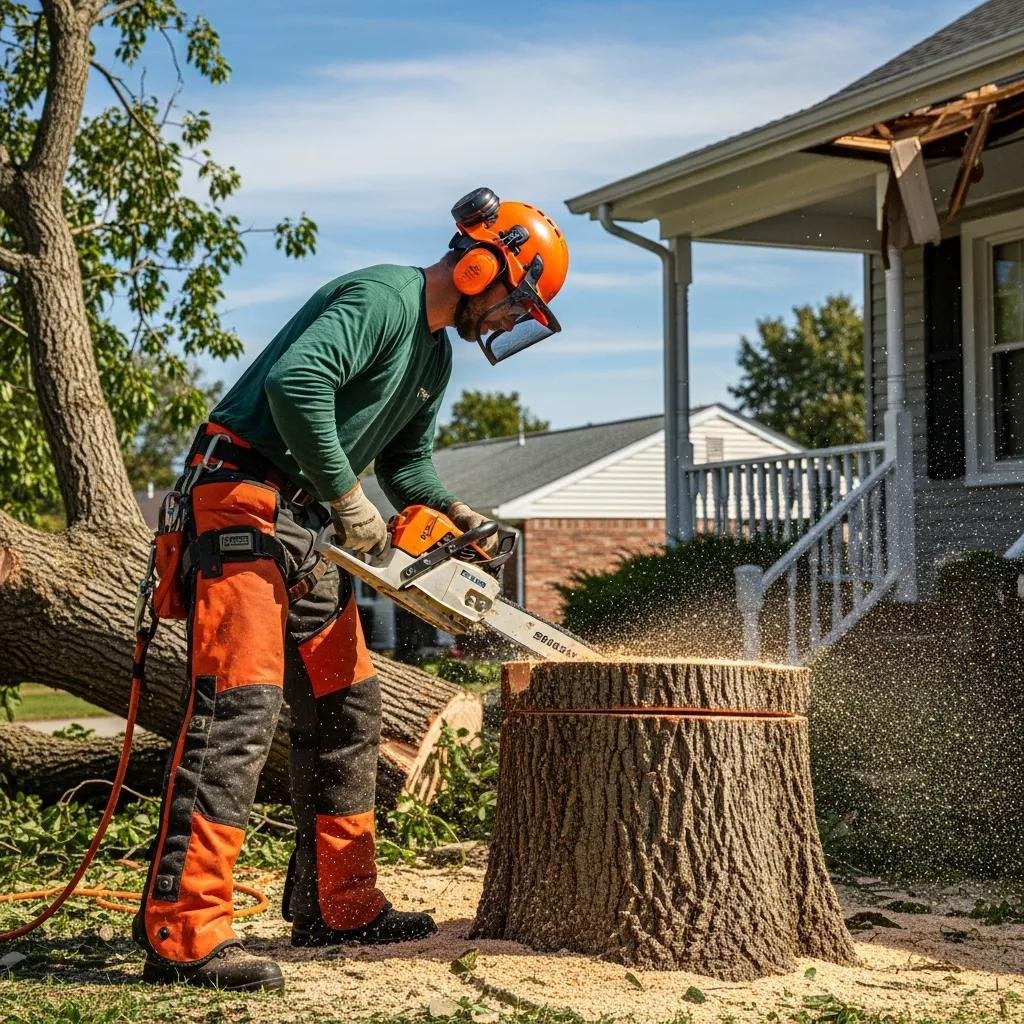
Emergency Tree Service: What You Need to Know About Urgent Tree Removal and Safety
Emergency tree service refers to immediate professional intervention when a tree poses an imminent risk to people, property, or critical infrastructure, and it is needed because safety cannot wait for standard scheduling. This guide explains how to recognize a tree emergency, what to expect from 24-hour emergency tree service, and practical steps for fallen tree cleanup and storm-damaged tree removal. Readers will learn signs of hazardous trees, the operational workflow of emergency crews, assessment methods used by certified arborists, and how cost and insurance typically interact with emergency work. The article also outlines how hazardous tree assessment is conducted, preventative measures to reduce future emergencies, and criteria for choosing a qualified emergency tree service provider. Throughout, terms like storm damage cleanup, hazardous tree removal, emergency arborist, and fallen tree cleanup are used to create semantic clarity and help you act safely and decisively when time matters.
What Defines a Tree Emergency and When Should You Act?
A tree emergency exists when a tree or large limb creates an immediate threat to life, buildings, vehicles, or utilities and requires rapid removal or stabilization to prevent imminent harm. The mechanism of danger is usually structural failure—such as root plate pullout, trunk splitting, or crown collapse—that can rapidly evolve during storms or after impact, and the benefit of prompt action is reduced damage and improved safety. Homeowners who understand the decision rules for when to act can avoid unnecessary risk and speed up professional response. The following signs help prioritize action and prepare for a rapid response from emergency crews.
Recognizing these signals early allows you to secure the scene and call for help, which leads naturally to understanding what a professional 24-hour emergency tree service will do next during response and removal.
The most urgent signs of a hazardous tree include:
- Significant leaning or sudden tilt with exposed roots indicating a failing root plate.
- Large trunk cracks, visible splits, or active trunk movement under load.
- Tree limbs or crown sections in contact with a structure, vehicle, or power line.
- Visible fungal conks, rot cavities, or advanced crown dieback suggesting internal decay.
These signs indicate direct risk and should trigger immediate safety actions such as evacuating the area, keeping clear of the tree, and calling emergency services or a qualified emergency arborist. Noting these indicators also prepares you for the initial information emergency dispatchers will request when arranging a rapid response.
What Are the Signs of a Hazardous Tree Requiring Immediate Attention?

A hazardous tree shows physical symptoms that signal imminent failure and elevated risk to people and property. Visible cracks, splitting bark, and seams along the trunk show structural compromise, while root exposure or a lifted root plate indicates the tree is losing its foundation and can topple during wind. Fungal fruiting bodies and hollowed cavities are indicators of internal decay, signaling that the tree’s internal structure no longer supports the crown. These observable signs often co-occur and professionals use this syndrome of symptoms to prioritize urgent removal.
Each of these signs informs the triage decision: if a tree leans toward a house or power line, emergency stabilization or removal is needed right away. Understanding specific examples—like a maple with a propagating trunk crack or an oak with exposed root plate after saturated soil—helps homeowners describe conditions accurately during an emergency call, improving response speed and safety.
What Common Events Cause Tree Emergencies?
Tree emergencies most often follow acute external events that overload tree structure or accelerate decay, creating scenarios that convert a healthy-looking tree into an immediate hazard. Severe weather such as high winds, ice storms, and lightning can cause sudden limb failure or uprooting, while saturated soils after heavy rain reduce root anchorage and increase overturn risk. Mechanical impacts from vehicles, construction damage to roots, and progressive pest or disease infestations gradually weaken trees until a sudden failure occurs.
When these events happen, the immediate homeowner actions are similar: keep people and pets away, avoid touching fallen limbs near utilities, and document the scene for insurance if it is safe to do so. Recognizing common causes and recommended immediate actions helps triage incidents and leads directly into how 24-hour emergency tree service organizes its response and the equipment they use.
How Does 24 Hour Emergency Tree Service Work?
A 24-hour emergency tree service operates on a rapid triage-to-removal workflow designed to prioritize life-safety, protect property, and restore safe access as efficiently as possible. The mechanism begins with a call or online request that provides location and hazard details, followed by dispatcher triage to determine urgency and resource needs; on-site crews then perform a scene assessment, isolate hazards, and implement a removal or stabilization plan. The specific benefit of this approach is reduced response time and minimized secondary damage from falling limbs or compromised trees. Understanding this workflow prepares homeowners for what to expect and how to help the crew on arrival.
The typical process emphasizes clear communication and safety at every stage, and the structured response sequence below clarifies expectations while highlighting the types of emergency services commonly provided.
- Assessment: Dispatcher gathers location, hazard type, and immediate risks to assign appropriate crews.
- Safety Isolation: Crews set up exclusion zones, coordinate with utilities if needed, and stabilize structures before cutting.
- Removal & Rigging: Technicians use rigging, chainsaws, or cranes for controlled removal of the tree or limbs.
- Cleanup & Haul-Away: Chipping, debris hauling, and site restoration conclude the operation to restore safe conditions.
This stepwise process shows how emergency arborists translate initial reports into prioritized action; it also highlights why homeowners should provide clear information during the call and follow safety instructions while waiting for crews. The next section expands on what that initial call and onsite interaction will typically involve.
Types of emergency tree services compare by use case and expected timeframe:
| Service Type | Typical Use Case | Typical Outcome / Timeframe |
|---|---|---|
| Emergency removal (no access issues) | Tree leaning into yard or minor structure contact | Controlled removal within hours |
| Crane-assisted removal | Large tree near structure or limited access | Multi-hour lift with precision cuts |
| Hazardous pruning and stabilization | Partially failed limbs or partially decayed trunk | Immediate pruning and short-term cabling |
| Fallen tree cleanup | Tree blocking driveway or road | Debris removed and access restored same day |
What to Expect During an Emergency Tree Removal Call?
During an emergency call, dispatchers will rapidly collect essential details—your location, the nature of the hazard, whether people are injured, and whether utilities are involved—to determine the proper crew response. The mechanism here is efficient triage: accurate initial information helps dispatch the right combination of technicians, a bucket truck, or a crane, and it shortens arrival time. Expect immediate safety instructions such as evacuating the structure, keeping clear of the area, and avoiding contact with downed power lines. Clear, calm answers to dispatcher questions and following safety advice help crews mobilize effectively and protect life and property.
This early interaction leads directly to the on-site assessment where crews confirm hazards and deploy equipment, which we describe next to help homeowners understand the tools and techniques used to mitigate danger.
Which Specialized Equipment Is Used in Emergency Tree Services?
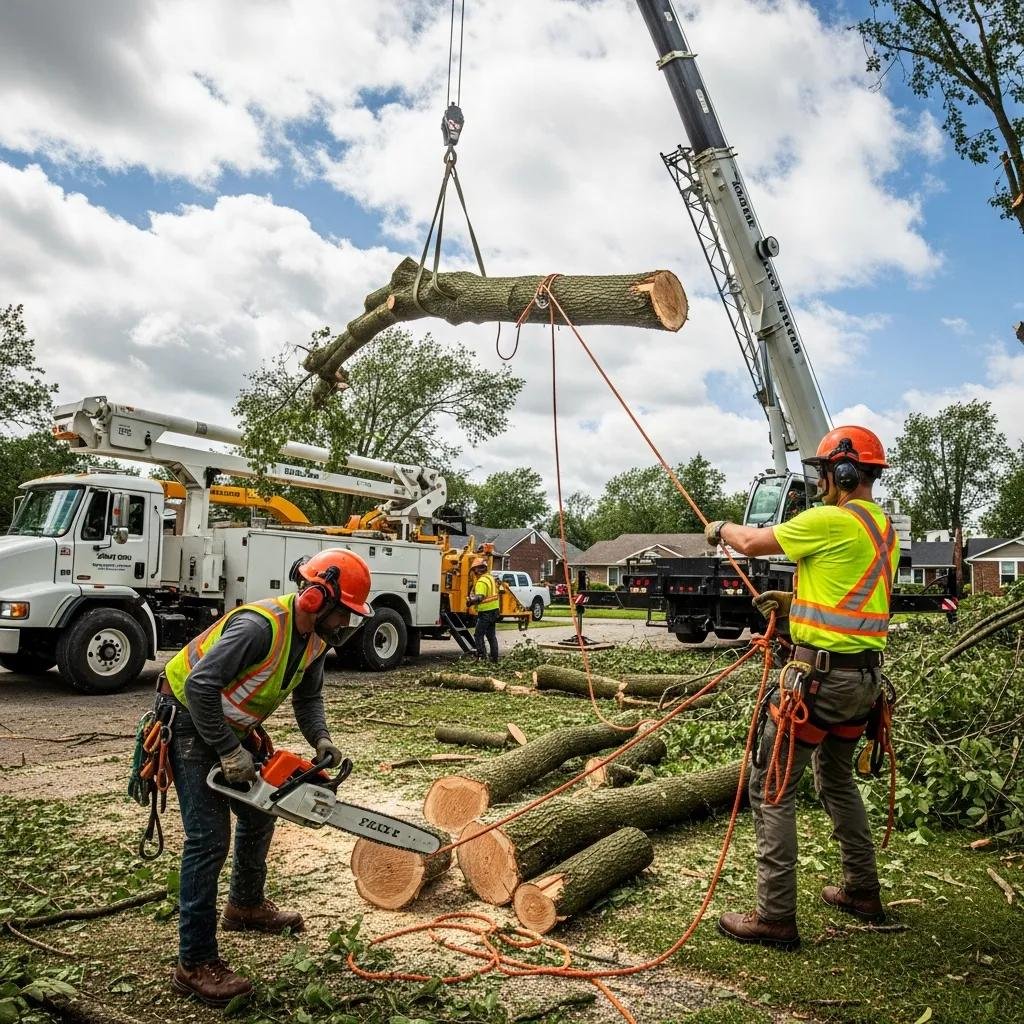
Emergency tree crews use a predictable set of equipment—chainsaws, rigging systems, cranes, bucket trucks, chippers, and haul-away trucks—each selected for its role in safe, efficient removal and cleanup. Chainsaw operations with specialized bar lengths handle standard removals, while crane-assisted removal is necessary when a tree cannot be dropped safely or must be removed in sections near a structure. Chippers and debris-hauling equipment convert limbs into manageable material and remove it from the site, reducing trip hazards and restoring access. Safety protocols such as anchored rigging, tag lines, and exclusion zones are integral to every equipment use, and the presence of the right gear often determines whether a crew can complete work in one visit.
Understanding equipment choices helps homeowners appreciate why some jobs require larger crews or off-hour mobilization, and this awareness connects directly to the step-by-step approach used for fallen tree cleanup after storms.
What Are the Steps for Fallen Tree Cleanup and Storm Damaged Tree Removal?
Fallen tree cleanup and storm damaged tree removal follow a prioritized sequence focused on life-safety, documentation, and efficient restoration of access and function. The first step is scene safety and hazard isolation to protect people and utilities; next comes a documented assessment that records damage for insurance and informs the removal plan; the third phase is execution—controlled cutting, rigging, and removal—and the final phase is cleanup, chipping, and site restoration. This ordered approach reduces additional property damage and supports insurance claims by preserving a clear record of work and damage. Homeowners who understand these steps can better coordinate with crews and insurers during stressful post-storm conditions.
Below is a concise procedural checklist suitable for immediate action when a tree has fallen or a storm has caused visible tree damage.
- Ensure personal safety: evacuate endangered areas and keep clear of downed lines.
- Document damage with photos and notes before any work is performed, if safe to do so.
- Isolate hazards and coordinate with utility companies for electrical threats.
- Implement removal: cut and lower limbs, rig large sections, then chip and haul debris.
- Restore the site: grind stump if necessary, clear sidewalks/drives, and inspect remaining trees for stability.
How Is Storm Damage Assessed and Managed?
Storm damage assessment begins with a visual and structural survey to prioritize life and safety risks and to document conditions for insurance claims. Assessors categorize hazards—downed power lines and immediate roof penetration take top priority—then evaluate tree stability, root condition, and remaining live crown to recommend removal, pruning, or short-term stabilization. Documentation for insurance typically includes dated photos, measurements of affected structures, and a written description of the hazard and recommended remedial work. Effective assessment balances immediate mitigation needs with thorough documentation so homeowners can both secure their property and support claims.
Accurate assessment informs the specific removal techniques used and the protective measures applied during cleanup, which we cover in the following section about safety measures taken during fallen tree cleanup.
What Safety Measures Are Taken During Fallen Tree Cleanup?
Safety measures during cleanup include establishing exclusion zones, using full personal protective equipment (PPE), employing proper rigging and descent control for heavy limbs, and coordinating with utility providers when electrical hazards exist. Crews set hoarding, signage, and traffic control when work occurs near roads, and they use certified rigging to prevent uncontrolled falls. When power lines are involved, the protocol is to isolate the area and wait for utility crews—no crew or homeowner should touch lines—so coordination with the utility is paramount. These practices protect workers and the public and minimize secondary incidents during what can be chaotic post-storm operations.
Implementing these safety protocols reduces the likelihood of injury and property damage and directly connects to longer-term hazard mitigation techniques explored in hazardous tree assessment.
How Is Hazardous Tree Assessment Conducted and Why Is It Important?
Hazardous tree assessment is a professional process that combines visual tree assessment methods with targeted testing to rate risk and recommend mitigation, and its importance lies in making data-driven choices between removal and preservation. Professionals use techniques such as visual inspection for decay indicators, resistograph or sonic tomography testing for internal defects, and root plate examination to determine anchorage. The value of a formal assessment is that it provides a defensible risk rating and a plan—removal, pruning, cabling and bracing, or monitoring—that optimizes safety, cost, and tree preservation. Engaging qualified assessors reduces liability and improves long-term landscape resilience by addressing root causes rather than symptoms.
Who Is a Certified Arborist and What Is Their Role in Tree Risk Assessment?
A certified arborist is a trained professional, often verified through recognized credentialing bodies such as the International Society of Arboriculture (ISA), who understands tree biology, structural evaluation, and safe tree practices; their role is to analyze tree health, perform risk assessments, and recommend mitigation strategies. An arborist’s report commonly includes a description of observed defects, a risk rating, recommendations for immediate action, and suggested follow-up—pruning, removal, cabling/bracing, or monitoring. Verification of credentials gives homeowners confidence that the assessment follows standardized methods and that recommended work aligns with industry safety protocols. Relying on certified expertise ensures that interventions are appropriate to the tree’s condition and that work follows best practices for both safety and preservation.
What Preventative Measures Reduce Future Tree Emergencies?
Preventative measures include scheduled inspections, targeted pruning to remove weak limbs, soil management to support root health, and installation of cabling and bracing for structurally compromised trees. Regular inspections detect early decay, pest activity, or root issues, while corrective pruning reduces leverage and wind loading that can precipitate failure. Structural support techniques such as cabling and bracing can extend a tree’s useful life and reduce the chance of catastrophic failure, and maintaining records of interventions helps guide future maintenance. These proactive steps reduce emergency risk and can lower long-term costs by preventing sudden, high-cost removals.
Proactive maintenance ties into cost considerations and insurance coverage topics, which influence decisions about when to call for emergency removal and how to document work for claims.
What Factors Influence Emergency Tree Removal Cost and Insurance Coverage?
Emergency tree removal costs are driven primarily by tree size, location and access difficulty, complexity of rigging or equipment required, and the urgency or after-hours nature of the call; insurance coverage commonly depends on whether the tree caused damage to an insured structure or created debris that meets policy terms. The mechanism of cost variation is straightforward: larger trees require more labor, heavier equipment such as cranes, and longer removal times, while obstructed access increases mobilization difficulty and expense. Typical price ranges vary widely by region and provider, but homeowners can expect higher rates for night-time emergency work and complex crane-assisted removals. Understanding cost drivers helps homeowners anticipate expenses and document conditions for potential insurance reimbursement.
Below is an EAV-style table that shows key cost factors, how they affect price, and example ranges to help homeowners quickly scan likely drivers of an estimate.
| Cost Factor | How It Affects Price | Example/Typical Impact |
|---|---|---|
| Tree size and weight | Larger trunks require more labor and equipment | Small tree: lower cost; large hardwood: significantly higher |
| Location / access difficulty | Tight yards or proximity to structures increases rigging time | Crane or sectional removal often required |
| Urgency / after-hours | Emergency mobilization and overtime raise rates | Night or weekend calls add premium |
| Utility involvement | Coordination with utility crews and safety limits increase cost | Requires additional time and possible hold-for-utility delays |
How Are Emergency Tree Service Costs Calculated?
Costs are calculated from a combination of labor hours, equipment use (chainsaws, cranes, bucket trucks), disposal and hauling fees, and any special site preparation or traffic control required; urgency and access complexity are multiplier factors in final pricing. Sample scenarios illustrate how components add up: a small yard tree that falls on a lawn has lower labor and disposal needs, while a large tree leaning into a house may require crane lifts, structural rigging, and more time, which increases cost substantially. Homeowners should request itemized estimates that list labor, equipment, and disposal separately to understand charges. Clear, itemized estimates also help when filing insurance claims by linking each cost to documented work performed.
| Scenario | Typical Cost Drivers | Typical Timeframe |
|---|---|---|
| Small fallen tree, clear yard | Labor, chip & haul | Same-day resolution |
| Medium tree on roof | Rigging, roof protection, debris removal | Several hours to a day |
| Large tree near structure | Crane, large crew, sectional removal | Multiple hours to full day |
Does Homeowners Insurance Cover Emergency Tree Removal?
Homeowners insurance often covers tree removal when a covered peril—such as wind or lightning—causes a tree to damage an insured structure, or when debris removal is necessary to make the property safe; policies commonly exclude pre-existing decay or lack of maintenance. The claims process typically requires prompt documentation: dated photos, an assessor’s or arborist’s report, and itemized contractor estimates. Homeowners should check policy language for debris removal limits, deductible interactions, and exclusions such as trees that fell due to neglect. When in doubt, document everything safely and consult your insurer promptly to determine covered remediation steps.
To assist homeowners, many emergency service providers offer claim-support services including on-site documentation and written estimates; using these services can shorten claim processing and ensure work is aligned with insurer expectations.
| Documentation Item | Purpose | How to Obtain |
|---|---|---|
| Photos (dated) | Evidence of damage and cause | Take multiple angles before work |
| Arborist report | Expert assessment of hazard and recommended action | Request a certified arborist evaluation |
| Itemized estimate | Links work to cost for claims | Ask provider for a detailed invoice |
How to Choose a Qualified Emergency Tree Service Provider?
Choosing a qualified emergency tree service provider requires checking verifiable credentials, confirming insurance coverage, evaluating equipment capabilities, and assessing responsiveness and reputation. The practical benefit of careful selection is safer work executions, fewer surprises on price, and appropriate documentation for insurance. Look for evidence of certified arborist expertise, proof of liability and workers’ compensation insurance, and the presence of specialized equipment such as cranes and bucket trucks when jobs require them. Asking targeted questions during initial contact and verifying references or reviews helps ensure you select a provider capable of safe, compliant emergency work.
Below is an EAV-style table to make credential verification fast and scannable so you can vet providers quickly during a stressful emergency.
| Credential / Feature | What It Indicates | How to Verify |
|---|---|---|
| ISA Certified Arborist | Trained in tree biology and risk assessment | Ask for certification number or written report |
| Liability & WC Insurance | Protection against property damage and worker injury | Request certificate of insurance |
| Specialized equipment (crane, bucket truck) | Ability to handle complex removals safely | Confirm equipment availability and operator qualifications |
| 24/7 emergency response | Rapid mobilization for urgent hazards | Ask about typical response times and after-hours policy |
What Credentials and Certifications Should You Look For?
When vetting providers, prioritize verifiable credentials such as ISA Certified Arborist status, proof of business liability and workers’ compensation insurance, and any relevant local licenses or permits required for tree work. These credentials indicate that the provider understands tree biology, uses safe practices, and carries financial protections in case of accident or damage. Verification can be done by requesting a certificate of insurance, an arborist’s credentials or report, and references for similar emergency work. Confirming these items before engaging a crew reduces liability and increases the probability that the work will follow industry safety and ethical standards.
Establishing these verification steps helps homeowners make a fast, informed hiring decision during emergencies and ties directly to why responsiveness and reputation are critical considerations, which we discuss next.
Why Is 24/7 Availability and Customer Reputation Important?
Availability matters because response time directly affects safety and the extent of secondary damage; providers that offer 24/7 emergency response can stabilize hazards faster and often prevent greater property loss. Customer reputation—documented reviews, before/after photos, and references—indicates consistent service quality under pressure and shows that a provider can handle the logistical and safety complexities of emergency work. A short vetting checklist for reputation includes checking recent reviews, requesting case examples of similar emergency removals, and asking for references from local property managers or municipalities. Prioritizing responsiveness and verified reputation improves outcomes and reduces the likelihood of work that creates new hazards.
Taking these vetting steps leads naturally to the practical final actions a homeowner should take when an emergency arises and to the availability of providers who can assist immediately.
For homeowners needing immediate assistance, a hypothetical emergency tree service offering 24/7 response, certified arborist assessments, and equipment for crane-assisted removal can mobilize to secure the scene and provide documentation for insurance claims. While no specific company details are provided here, many providers advertise these capabilities and can supply itemized estimates and on-site reports to support claims and decision-making.
- Ask for credentials: Request proof of certification and insurance before work begins.
- Get an itemized estimate: Ensure labor, equipment, and disposal are listed separately.
- Document everything: Take photos and obtain a written arborist assessment to support insurance claims.
If you need help assessing a hazardous tree, arranging a rapid response, or documenting storm damage for insurance, emergency tree services with 24/7 response and certified arborist expertise are equipped to assist—contact a local emergency tree professional or request an on-site assessment to begin the process.