The Ultimate Guide to Professional Tree Removal: Costs, Safety, and Choosing the Right Service
Professional tree removal is the systematic assessment, planning, and execution of taking down a tree that poses a risk or no longer fits a property’s landscape, performed by trained crews using industry-grade equipment. Understanding costs, safety procedures, and how to choose a qualified arborist matters because misjudged removals create hazards, hidden expenses, and legal headaches. This guide explains the tree felling process, cost drivers including stump grinding and debris removal, legal and environmental considerations such as permits and habitat protection, and how to assess emergency removal needs. Readers will learn practical decision criteria—when to preserve versus remove, what tools and PPE professionals use, and which questions to ask prospective companies before signing an estimate. Throughout, the article uses industry terminology like arboriculture, stump grinding, crane-assisted removal, and tree risk assessment, and it points to sustainable post-removal options to reduce long-term costs and ecological impact. By the end you’ll be equipped to evaluate bids, understand safety standards, and engage professional tree removal services confidently when needed.
What Are the Key Factors Affecting Professional Tree Removal Cost?
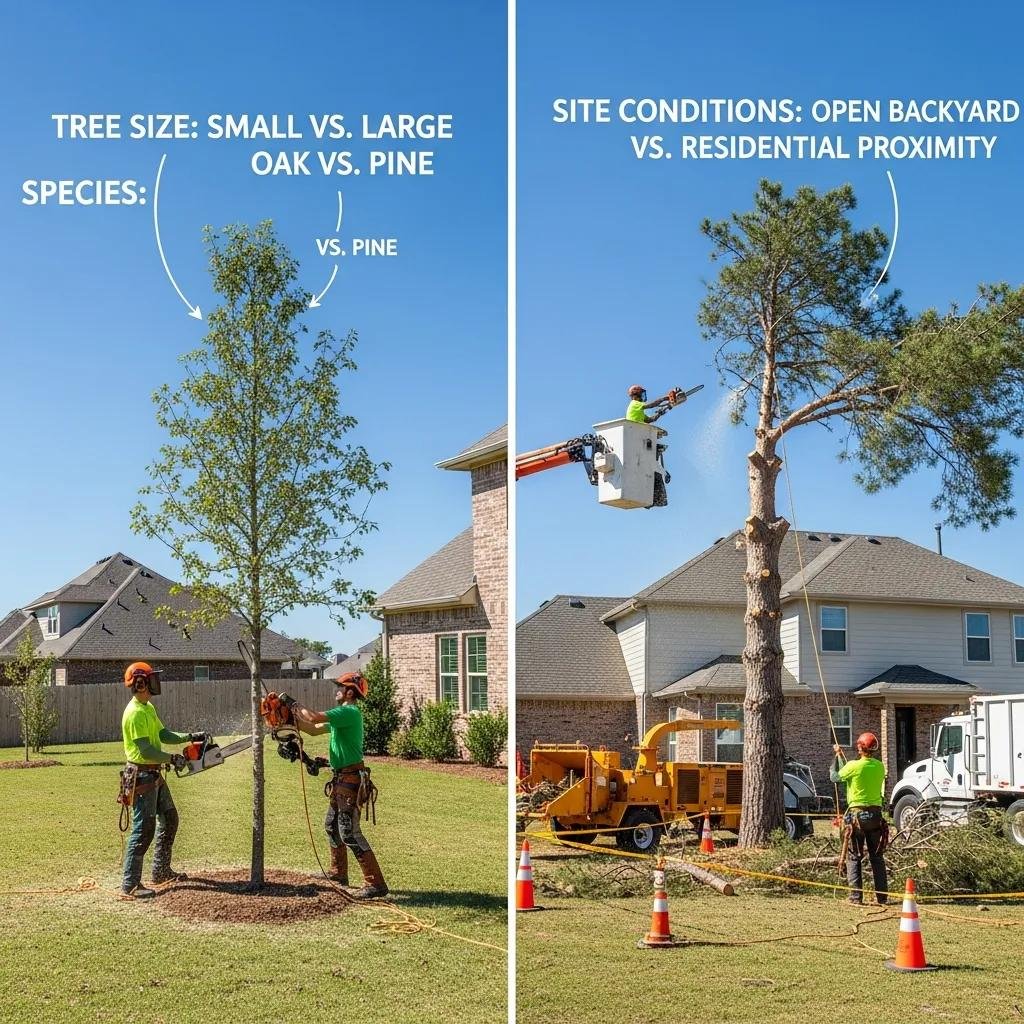
Tree removal cost depends on a mix of objective attributes and situational modifiers that change labor, equipment, and disposal needs. Size and species drive base effort: height and trunk diameter determine climb time and cutting complexity; certain species require extra caution due to brittle limbs or dense wood. Site factors such as proximity to structures, overhead utilities, and yard access add risk premiums because they require sectional dismantling, rigging, or crane assistance. Tree condition—healthy, diseased, or dead—alters urgency and safety practices, often increasing cost when crews must mitigate collapse risk. Finally, add-on services like stump grinding, hauling chippings, and permit procurement create identifiable line items on estimates and influence the total project price.
Different cost drivers map clearly to impact on pricing and logistics, as shown in the table below that compares common scenarios and typical impact multipliers for budgeting and planning.
| Scenario | Key Attribute | Typical Pricing Impact |
|---|---|---|
| Small backyard maple (≈20 ft) | Easy access, low diameter | Low — baseline labor and single crew |
| Large roadside oak (≈70 ft) | Height, trunk diameter, street access | High — requires sectional removal, traffic control |
| Dead/leaning tree near house | Structural instability | Very high — risk premium, slower safe removal |
| Tight fenced yard or over house | Limited access, need for cranes or manual lowering | Very high — specialized equipment and time |
This comparison helps homeowners and property managers estimate relative cost expectations and prioritize safety measures. Understanding these drivers prepares you to ask targeted questions when comparing written estimates and to spot unusually low bids that may omit necessary safety or disposal work.
How Do Tree Size and Location Influence Removal Pricing?
Tree size and location directly change the labor intensity and equipment profile of a removal job by increasing the time to perform cuts, rigging complexity, and crew coordination. Taller trees and wider trunk diameters require more cutting passes, larger rigging systems, and often a second crew to manage lowered sections, which increases hourly labor and equipment rates. Trees adjacent to homes, garages, fences, or utility lines require sectional dismantling, controlled lowering, or crane-assisted lifts to prevent collateral damage, each adding cost and permitting time. Restricted access — such as fenced yards, steep slopes, or gated properties — converts what would be a standard removal into a logistical challenge that can double or triple labor hours.
Concrete examples clarify these differences and help clients assess bids: a 20-foot backyard maple removed with basic chainsaw and chipper access is a routine job, while a 70-foot roadside oak requiring traffic control, sectional rigging, and possible crane time will list multiple premium line items. Recognizing these situational differences reduces surprises and ensures bids are comparable across providers.
What Additional Costs Arise from Stump Grinding and Debris Cleanup?
Stump grinding and debris cleanup are common add-ons that vary by stump size, root complexity, and desired site finish, and they often account for a significant share of the final invoice. Stump grinding prices generally depend on grind depth (surface slice vs deep root grind), the diameter of the stump, and the time required to remove large root systems; grinding is usually more cost-effective than full stump excavation but leaves some root tissue to decay. Debris cleanup and wood disposal fees depend on chip volume, distance to disposal or recycling facilities, and whether wood is recycled as mulch or hauled away as green waste; some providers include chipping in the base price while others itemize it.
Homeowners should consider three common disposal choices and their trade-offs:
- Mulch on site for landscape reuse, reducing waste and delivering immediate value.
- Haul to municipal green waste or recycling, which may incur tipping fees.
- Remove and truck to a wood recycling facility or firewood processing, often higher cost but cleaner site.
Choosing the right combination depends on intended future use of the area and tolerance for site disruption; discussing these options during the estimate phase prevents later disputes over scope and costs.
How Does the Professional Tree Felling Process Ensure Safety and Efficiency?
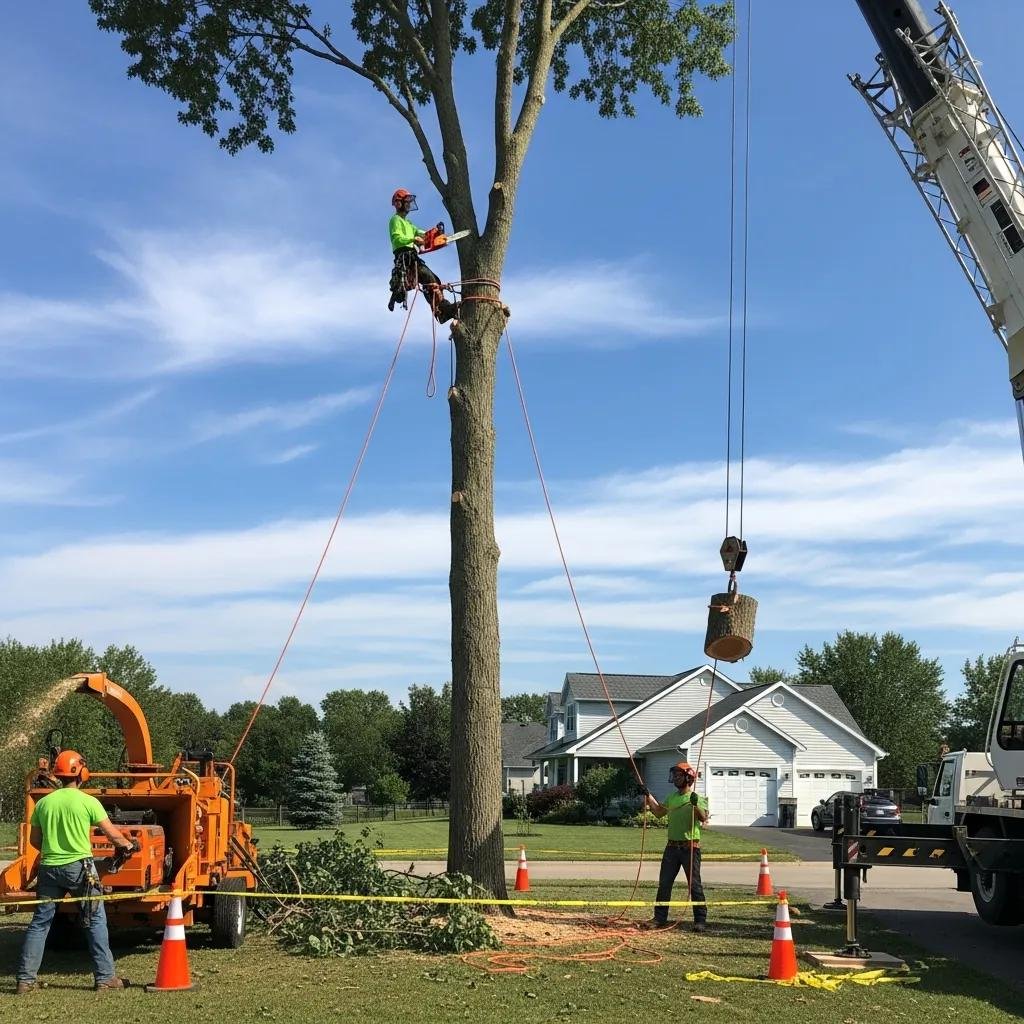
Professional tree felling follows a structured workflow—assessment, permitting, planning, execution, and cleanup—designed to reduce risk, ensure regulatory compliance, and optimize crew efficiency. The assessment phase identifies hazards, root stability, and tree health and produces a removal plan that defines drop zones and required equipment. Permitting and municipal checks occur where local regulations apply, and the planning phase allocates crew roles, establishes exclusion zones, and determines whether specialized equipment like cranes or bucket trucks are necessary. During execution, certified arborists and trained ground crews use directional cuts, rigging, and signalling protocols to control the descent of large limbs and trunks. Finally, cleanup and site restoration close the loop with stump options, chip distribution, and debris removal that prepare the site for replanting or landscape restoration.
Below is a process-to-safety mapping that shows each major step, associated safety measures, and the responsible party on a professional crew.
| Process Step | Primary Safety Measure | Responsible Party |
|---|---|---|
| Assessment & risk scoring | Visual inspection, sounding, and decay checks | Certified arborist |
| Permitting & notifications | Documentation, utility notifications | Project manager / contractor |
| Planning & drop zone setup | Traffic control, exclusion fencing | Ground crew lead |
| Execution & dismantling | Rigging systems, spotters, PPE | Climber/lead arborist |
| Cleanup & disposal | Chipper operation, stump grinding | Ground crew / equipment operator |
This table clarifies accountability and helps clients verify that estimates include the necessary safety and administrative elements to protect people and property. Properly documented procedures also facilitate smoother insurance and municipal interactions when required.
What Are the Safe Tree Removal Techniques Used by Certified Arborists?
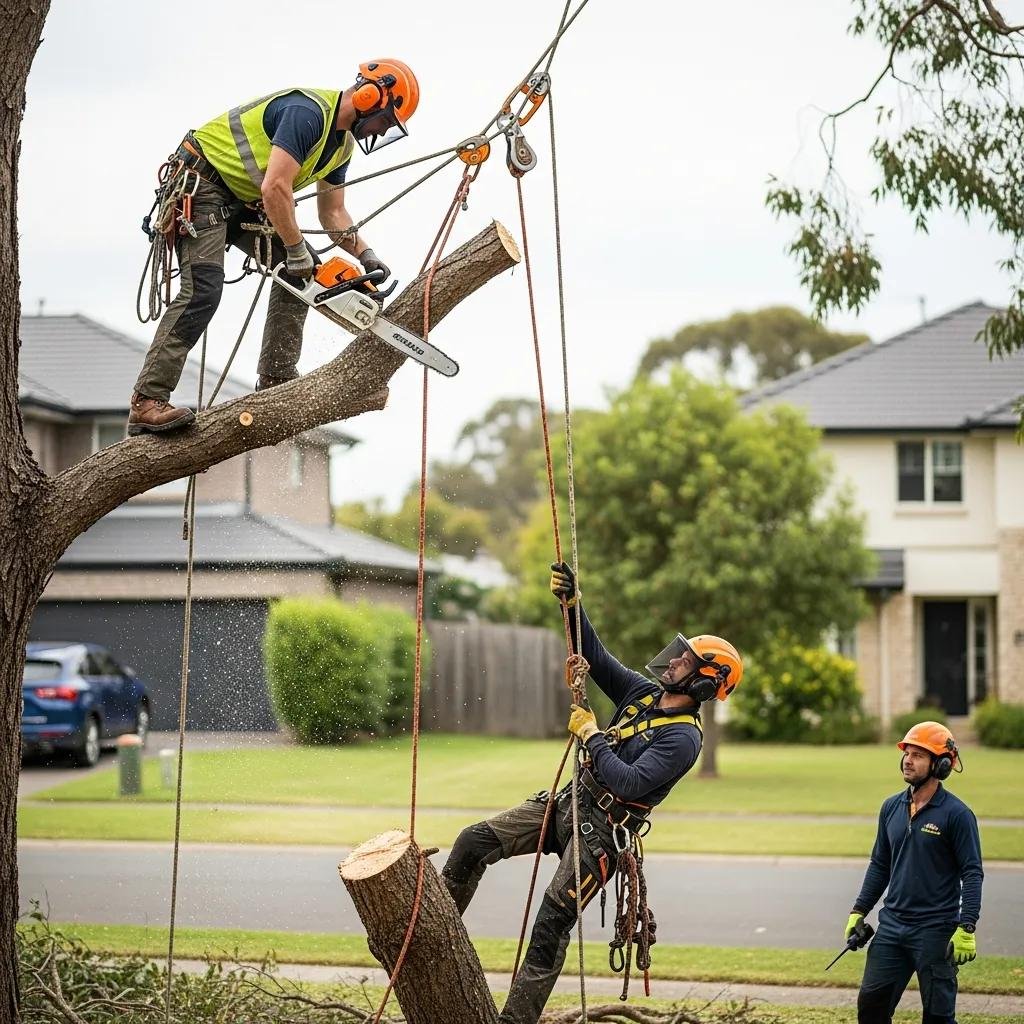
Certified arborists select techniques based on tree size, site constraints, and risk profile, using directional felling, sectional dismantling, lowered rigging, and occasionally crane-assisted removal to manage hazards safely. Directional felling is used when there is sufficient clear space, allowing a tree to be guided to a planned drop zone by strategic cut placement; this technique minimizes rigging but requires buffer clearance. Sectional dismantling is the preferred method in tight urban lots or near structures—arborists remove a tree in controlled pieces, using rope-and-pulley systems to lower heavy sections safely to the ground. When sectional lowering is insufficient due to access constraints or proximity to sensitive infrastructure, crane-assisted removal permits safe hoisting of large sections at higher cost but lower surface risk.
Understanding these techniques helps homeowners evaluate whether a quoted method matches their property’s constraints and why certain methods carry higher labor or equipment charges. Proper technique selection is both a safety decision and a cost driver.
Which Equipment and Safety Gear Are Essential for Tree Felling?
Essential equipment and personal protective equipment (PPE) form the backbone of safe and efficient tree felling: chainsaws sized to the job, stump grinders, chippers, rigging hardware, cranes or bucket trucks when necessary, and a full complement of PPE. PPE should include a hard hat, eye protection, hearing protection, chainsaw chaps, gloves, and steel-toe boots, and crews must use high-visibility clothing and appropriate fall-arrest systems when climbing. Equipment like grapples, lowering devices, and certified slings reduces uncontrolled drops, while chippers and stump grinders speed cleanup and minimize manual handling hazards. Regular equipment maintenance and pre-job safety briefings are additional non-tangible safety elements that significantly lower incident rates.
The importance of these safety measures is underscored by studies analyzing the common causes of incidents in arboricultural operations.
Arboriculture Safety: Fatal & Nonfatal Incident Review
The objective of this study was to identify and quantify the hazards present during arboricultural operations. The Occupational Safety and Health Administration Fatality and Catastrophe incident database and other Bureau of Labor Statistic sources were analyzed for arboricultural operation incidents within the 17-year period from 2001 through 2017. There were 865 fatal and 441 nonfatal incidents reviewed from this period. The leading four fatal incidents, from the largest to the smallest number of fatalities, were climber falls, workers struck by a falling tree, workers making indirect contact with an electric current, and workers struck by a falling branch. Climber falls were also the leading incident for severe nonfatal injuries, followed by ground workers struck by a falling branch, workers struck by a chain saw, and falls by aerial device operators.
Tree risk assessment methods: A comparison of three common evaluation forms: ENH1226/EP487, 11/2013, AK Koeser, 2013
A checklist of essential items helps property owners confirm that a provider is prepared and compliant:
- Hard hats, eye and hearing protection, chainsaw chaps.
- Properly maintained chainsaws, chippers, and stump grinders.
- Rigging gear, slings, and lowering devices with certification.
- Traffic control and exclusion signage where public safety is involved.
This checklist supports informed conversations with prospective providers and helps validate written estimates that reference specific equipment or safety procedures.
How to Choose the Right Tree Removal Company for Your Needs?
Choosing the right tree removal company requires evaluating credentials, insurance, written estimates, and references to ensure safety, legal compliance, and fair pricing. Verify that the provider employs or consults certified arborists and follows industry safety standards; certifications such as ISA certification and Tree Care Industry Association alignment are meaningful indicators of technical competence and ongoing training. Insurance verification is critical—confirm general liability and worker’s compensation coverage and ask for policy limits in writing. Written estimates should outline scope, cleanup responsibilities, permit handling, and payment terms; clear contracts prevent scope creep and hidden fees.
Here is a prioritized checklist of what to verify during the vetting process to ensure you select a competent and responsible provider.
- Proof of professional certification and arborist involvement in the assessment.
- Evidence of general liability and worker’s compensation insurance with stated limits.
- A written, itemized estimate that includes scope, equipment, cleanup, and permit handling.
- References or documented project examples for similar jobs in comparable settings.
Using this checklist when comparing bids makes it easier to spot red flags such as unusually low prices, lack of a written contract, or refusal to show insurance documentation. These checks protect you from liability and ensure a safer removal.
After you evaluate credentials and scope, a brief note about services professionals commonly advertise may help you take the next step: many providers promote comprehensive tree removal services—assessment, felling, stump grinding, debris removal, and emergency response—emphasizing safety through certified arborists and reliability through rapid-response teams. When you are ready to proceed, request a written estimate that references these specific services and ask how the company documents safety procedures and disposal options.
What Qualifications and Certifications Should a Tree Removal Service Have?
Key qualifications include a certified arborist on staff or consulted during the assessment, training records for field crews, and membership or compliance with recognized industry bodies that promote safety and best practices. ISA certification indicates specialized knowledge in tree biology, risk assessment, and pruning standards, while affiliation with trade associations signals commitment to continuing education. Insurance credentials should include general liability to protect property and worker’s compensation to cover on-the-job injuries; you should ask to see certificates and confirm effective policy dates. Additionally, ask whether subcontractors are used and whether they are covered under the same insurance umbrella to avoid gaps in liability.
Verifying these items reduces risk and aligns expectations about work quality and compliance, and it gives you concrete items to request during the estimate and contracting phases. Clear verification practices support better outcomes and smoother municipal or insurance interactions.
Which Questions Should You Ask Before Hiring a Tree Removal Company?
Asking targeted, prioritized questions reveals competence, transparency, and a provider’s approach to site-specific risks and cleanup obligations. Ask how the company will assess tree risk and what method they recommend for the specific site; request an explanation of equipment needs, crew size, and expected timeline. Confirm who will pull permits if required, how debris will be handled, and whether stump grinding is included or optional. Inquire about written guarantees for property protection, whether tree disposal is handled sustainably, and how emergency scenarios are triaged.
Sample questions and ideal responses include:
- “Will a certified arborist perform the assessment?” — Ideal: Yes; arborist will produce a written plan.
- “Who obtains permits if required?” — Ideal: Contractor handles permitting and provides copies.
- “Is cleanup and chipping included?” — Ideal: Itemized in the estimate with disposal options.
Asking these questions and expecting clear, documented answers separates professional providers from those likely to deliver substandard or risky work.
When and How Should You Use Emergency Tree Removal Services?
Emergency tree removal is for situations that pose immediate danger to life, property, or critical infrastructure and requires rapid triage and mitigation by trained crews operating under expedited protocols. Emergencies include storm-damaged trees that threaten collapse, large limbs suspended over occupied structures, and trees down on utility lines where immediate hazards to electrical safety exist. Emergency crews prioritize stabilizing hazards, protecting people, and securing the site; they may perform temporary mitigation to reduce acute risk followed by scheduled full removal when conditions permit. Calling professional emergency services quickly is essential, because delay increases the likelihood of property damage and complicates insurance claims.
Below is a concise criteria list to identify scenarios that require urgent professional attention and immediate homeowner actions to stay safe while waiting for responders.
- Tree leaning with visible trunk cracks or separated root plate near structures — evacuate the immediate area.
- Large limbs hanging over occupied buildings or public walkways — keep people clear and cordon the zone.
- Trees downed on power lines — do not approach; notify utility company and call emergency services.
- Sudden trunk failure or audible cracking during a storm — treat as immediate hazard and seek professional response.
This direct criteria helps homeowners triage risk and choose between non-urgent scheduling and emergency response, and it frames expectations for what an emergency crew will do on arrival.
Emergency removal teams typically follow a rapid-response workflow that combines triage, temporary stabilization, and scheduling for complete removal; many professional services advertise rapid availability and 24/7 responsiveness as part of their emergency offerings. When you call an emergency crew, expect an immediate safety assessment, temporary hazard reduction (such as lowering dangerous limbs or installing shoring for a leaning trunk), and a clear plan for follow-up work; this responsiveness minimizes further damage and expedites insurance documentation.
What Situations Require Immediate Professional Tree Removal?
Immediate removal is required when there is an imminent threat to life or property, such as a tree that is actively failing, a leaning trunk with exposed roots, large hanging limbs that can fall unpredictably, or trees contacting power lines. In these cases, delay increases risk and complicates both mitigation and insurance claims. Homeowners should evacuate unsafe zones, keep clear of downed lines, and avoid attempting DIY cutting or stabilization, which can worsen hazards. Contacting professional crews promptly ensures trained responders address the highest-risk elements first and prevents unnecessary exposure.
Understanding these triggers helps homeowners prioritize emergency calls and communicate effectively with responders about observed signs of acute failure so crews can plan immediate actions.
How Do Emergency Tree Removal Services Operate and Respond?
Emergency crews use triage protocols to prioritize the most serious hazards, often stabilizing a site with temporary measures before scheduling comprehensive removal and cleanup. The initial response focuses on life-safety: securing the area, shoring unstable trees, and coordinating with utilities for situations involving power lines. Once the acute risk is mitigated, crews plan the full removal using the appropriate techniques—directional felling, sectional dismantling, or crane assistance—depending on site constraints. Emergency services also document damage and actions taken to support insurance claims and may coordinate with municipal services when public infrastructure is affected.
Knowing this response pattern prepares homeowners to provide useful information during the initial call and to understand why temporary measures may precede final cleanup, helping set realistic expectations for timing and cost.
What Are the Legal and Environmental Considerations in Tree Removal?
Tree removal often intersects with permits, protected species rules, and environmental best practices, so homeowners should determine local regulatory triggers and sustainable disposal strategies before contracting work. Permits are commonly required for trees above a certain diameter, for protected species, or for removals in designated conservation or urban canopy zones; failing to secure required permits can result in fines or forced remediation. Environmental practices include recycling wood into mulch, donating suitable logs as firewood, or using chippings for erosion control; these choices reduce landfill impact and support habitat-sensitive outcomes. Proper documentation—photographs, permits, and written assessment—also helps with insurance claims and municipal compliance when removals are contested.
To clarify when permits are typical and how to obtain them, follow the stepwise guidance below and prepare the necessary documentation in advance of any removal.
| Trigger for Permit | Typical Documentation Required | Who Usually Files |
|---|---|---|
| Diameter threshold or protected tree | Photos, measurements, species ID | Owner or contractor (varies by locality) |
| Trees in conservation or historic zones | Application, mitigation plan | Owner/contractor with municipal approval |
| Removals affecting public right-of-way | Traffic control plan, liability insurance proof | Contractor or utility company |
When Are Tree Removal Permits Required and How to Obtain Them?
Permits are typically required when trees exceed local size thresholds, are species protected by ordinance, or when removal impacts public property or easements; the exact triggers vary by municipality and should be checked with local planning or parks departments. The common application process includes submitting photographs, tree measurements, species identification, and a description of reason for removal; some jurisdictions also require mitigation plans or replanting commitments. Turnaround times vary, so factor permit timelines into project scheduling. Contractors often assist with or handle permit filings on behalf of homeowners, which streamlines the process and ensures compliance with local rules.
Proactive permit checking prevents fines and project delays and ensures your removal aligns with community standards and environmental stewardship.
How Can Tree Removal Be Conducted Sustainably and Responsibly?
Sustainable tree removal minimizes ecological impact by prioritizing reuse, habitat considerations, and alternatives to full removal where practical—options include selective pruning, cabling for structural support, and replanting plans to replace canopy lost. Recycling wood into mulch or donating salvageable timber reduces waste, while strategic replanting with native species supports long-term canopy recovery. When removal is unavoidable, contractors can adopt habitat-sensitive timing to avoid nesting seasons and use low-impact machinery to reduce soil compaction. Documentation of mitigation steps and a replanting timeline also demonstrates environmental responsibility useful for municipal compliance and community relations.
These sustainable practices balance necessary tree work with long-term landscape health and often lower lifecycle costs by promoting rapid site recovery and reducing erosion or pest problems.
What Are the Post-Removal Services and Best Practices for Tree Care?
Post-removal services restore site usability and prepare landscapes for replanting or alternative uses, typically including stump grinding, full stump excavation, soil remediation, and replanting guidance to re-establish canopy and prevent erosion. Stump grinding is efficient for most landscapes and leaves a graded surface suitable for topsoil and sod; full stump removal (excavation) is selected when roots impede construction or for large specimen replanting. Soil remediation may include adding organic matter, aeration, and root barrier installation if replanting is planned. Best practices also cover timing—allowing a short settling period after grinding before heavy planting—and monitoring for sucker growth or disease in nearby trees.
The table below compares stump grinding against full stump removal and replanting to help homeowners decide which option aligns with landscape plans and budgets.
| Option | Characteristic | Benefit |
|---|---|---|
| Stump grinding | Removes visible stump to below grade, leaves roots | Lower cost, faster site restoration |
| Full stump removal | Excavates stump and major roots | Prevents regrowth, suitable for construction |
| Replanting | Soil prep, species selection, planting depth | Restores canopy, improves long-term value |
Professionals commonly bundle these post-removal services—stump grinding, debris disposal, and replanting advice—into full-service offerings that emphasize end-to-end responsibility, environmental disposal practices, and restoration planning. Asking providers for these bundled options can simplify logistics and ensure coordinated site recovery.
What Are the Options: Stump Grinding vs. Stump Removal?
Stump grinding uses a rotating cutter to reduce the stump to wood chips below ground level, is typically faster and less expensive than full excavation, and leaves roots that will decay over time; it’s ideal when planting or lawn restoration is the goal. Full stump removal involves excavating the stump and major roots, which is more invasive and costly but eliminates regrowth and root interference, making it the choice for new construction or when root systems threaten structures. Cost drivers include stump diameter, root depth, access, and whether site restoration or backfilling is required. Decision criteria should include future land use, tolerance for residual roots, and budget.
Choosing between grinding and removal should be made in the context of long-term landscape plans and potential construction needs so the selected method supports future property use without unnecessary expense.
How to Assess Tree Health and Decide Between Removal or Preservation?
Assessing tree health relies on visual checks and functional criteria: look for significant crown dieback, fungal fruiting bodies at the trunk base, deep trunk cracks, root plate upheaval, and high percentages of deadwood which signal structural decline. A basic diagnostic checklist helps homeowners decide whether treatment, monitoring, or removal is appropriate; minor defects may be addressed with pruning or cabling, while extensive structural failure or irreparable disease warrants removal. When in doubt, call a certified arborist for a formal tree risk assessment; the arborist can recommend preservation measures such as targeted pruning, pest treatment, or soil remediation when viable. Early intervention and professional assessment often save money compared with waiting until a tree becomes a hazard.
Indeed, professional risk assessment is a critical step in making informed decisions about tree health and safety, as highlighted by research into established methodologies.
Professional Tree Risk Assessment Methods
Experienced arborists can aid in this decision process by conducting a professional risk assessment that specifies the likelihood of whole or partial tree failure, the consequences of such a failure, and the potential targets affected. A variety of risk assessment methods have been developed to guide professionals through the tree inspection process. In North America, three risk assessment methods have gained the greatest acceptance among tree care professionals, municipal urban forestry programs, and government agencies.
Tree risk assessment methods: A comparison of three common evaluation forms: ENH1226/EP487, 11/2013, AK Koeser, 2013
Using these assessment steps and involving a qualified arborist when indicators are present ensures decisions balance safety, cost-effectiveness, and ecological value.
What Are the Options: Stump Grinding vs. Stump Removal?
Stump grinding and excavation were compared above; to summarize, grinding is cost-effective and suitable for most landscape restorations, while full removal is necessary when roots must be eliminated for new construction or to prevent regrowth. Professional providers typically offer both options and can recommend the best approach based on site goals, soil conditions, and timeline. Combining stump grinding with soil amendment and immediate replanting planning yields accelerated recovery and better long-term outcomes for selected replanting sites.
This service-level clarity helps you choose the option that aligns with both budget and future landscape plans, and it frames questions to ask providers during the estimate phase.
How to Assess Tree Health and Decide Between Removal or Preservation?
Evaluating tree health requires observing structural and biological signs—dead branches, fungal fruiting bodies, cracked or hollow trunks, and root instability—and interpreting these in the context of species longevity and site conditions. A decision flow typically goes: minor symptoms → preserve and monitor with pruning; moderate decline → treatment and reassessment; severe structural failure or significant pest/disease → removal. A certified arborist’s risk assessment combines visual inspection with species knowledge and site risk analysis to produce a recommended course of action. When preservation is feasible, targeted treatments and proactive maintenance extend tree life and reduce long-term costs compared with reactive removals.
Beyond immediate safety, the decision to remove or preserve a tree often involves a careful financial calculation, weighing long-term treatment costs against removal and replacement.
Economic Model for Tree Removal vs. Treatment Costs
A model is presented to assist in deciding the fate of ash trees (Fraxinusspp.) threatened by the arrival of emerald ash borer (Agrilus planipennisFairmaire) in North America. The model tracks ongoing treatment costs versus one-time costs associated with removal and replacement. All future values are discounted following standard economic practice. For each year over a period of interest, the net treatment gain/loss is calculated, indicating the period of time over which a homeowner would be financially ahead/behind by treating the existing ash tree.
To treat or remove: an economic model to assist in deciding the fate of ash trees threatened by emerald ash borer, JH Pedlar, 2012
Consistent monitoring and professional assessments ensure removal decisions are made on evidence and long-term property goals rather than short-term reaction.